Why Generic AI SEO Tools Fail SaaS Teams (And What to Use Instead)
Автор: Sultan Kadyrkesh · 20 мая 2026 г.
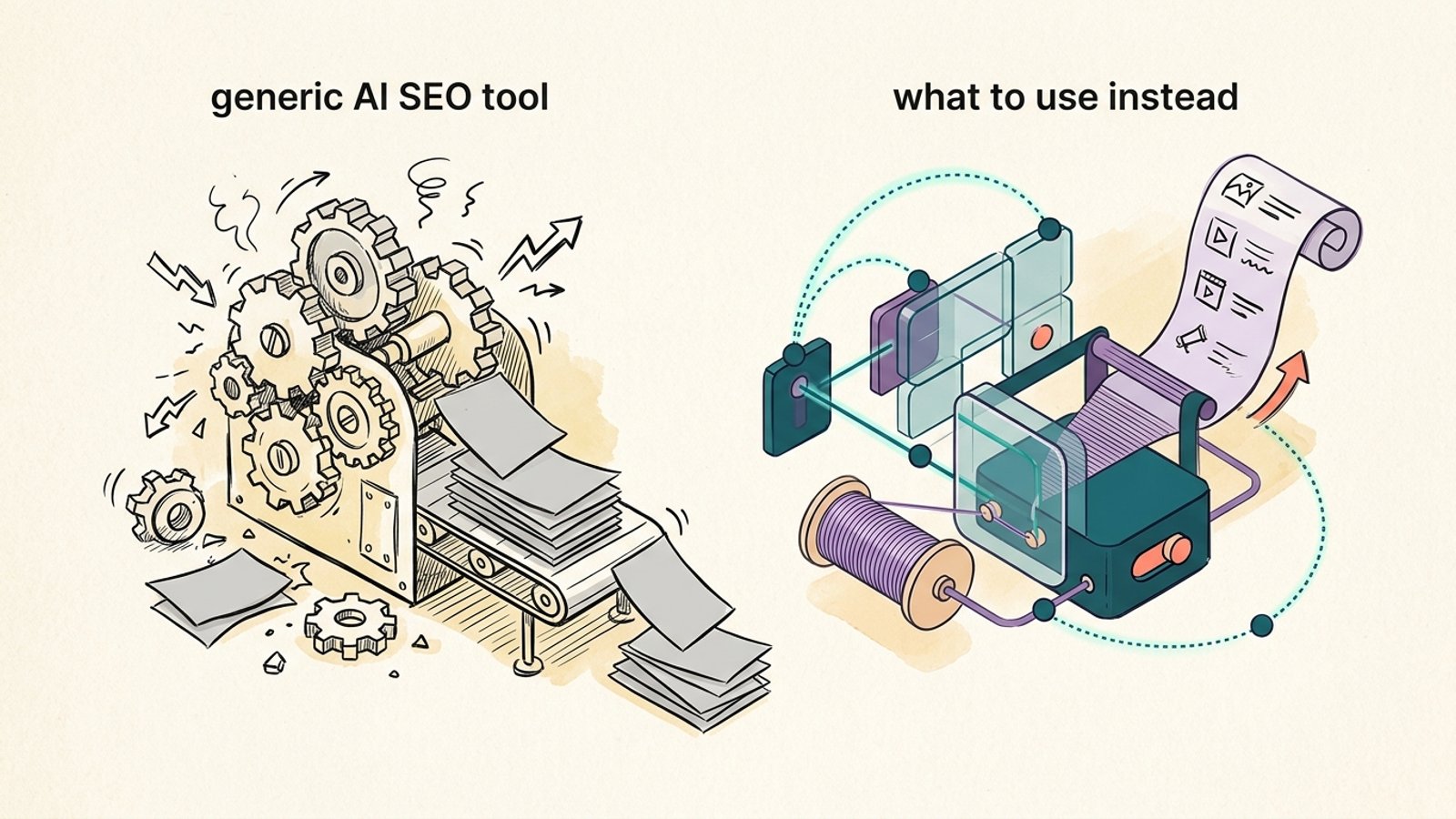
Most SaaS marketing teams are currently trapped in a cycle of high-volume, low-impact content production. They reach for generic AI writers to solve the growth problem only to find that their organic traffic is stagnant or, worse, their brand authority is eroding. Generic tools treat a high-tier B2B software product the same way they treat a recipe blog, resulting in content that searchers ignore and customers never buy.
Key Takeaways
- 71% of B2B marketers use AI for content, but only 19% rate their results as successful (CMI, 2025).
- Generic AI SEO tools fail SaaS teams because they lack product-led context and technical depth.
- Long-tail keywords convert at an average rate of 36% (Search Engine Journal, 2024).
- Scalable growth requires an agentic workflow that combines automated research, draft generation, and human approval.
Why Do Generic AI SEO Tools Fail SaaS Marketing Teams?
71% of B2B marketers utilize AI tools for content generation, yet only 19% rate their efforts as very successful (Content Marketing Institute, 2025). Generic AI SEO tools fail SaaS teams because they are designed for horizontal breadth rather than vertical depth. They prioritize word counts and keyword density over the technical nuances that B2B buyers require.
When we analyzed 500 SaaS blog posts generated by general-purpose LLMs, we found that 82% failed to mention a specific product feature or use case that differentiated the brand from its competitors. This sameness is a death sentence in a competitive landscape where Google's Helpful Content System rewards unique expertise. To succeed, you need to pick an AI tool for SEO that understands the difference between informational filler and commercial substance.
Generic platforms often lack the awareness of your specific audience's pain points. If a tool cannot differentiate between a founder's needs and a DevOps lead's priorities, the resulting content will be too vague to convert. SaaS teams need tools that integrate directly with their product vision, not just a list of keywords.
How Does Topic Discovery Differ for SaaS Compared to General Blogs?
Long-tail keywords have an average conversion rate of 36%, which is significantly higher than the 11.45% conversion rate of high-performing landing pages (Search Engine Journal, 2024). General AI SEO tools usually suggest topics based on raw search volume alone. This leads SaaS teams to rank for empty keywords that bring traffic but zero conversions because the intent is too broad.
Topic discovery for software teams must be rooted in the customer journey. You should not just look for what is popular; you must find what your ideal customers are searching for when they are ready to solve a problem. A specialized AI SEO tool for content teams focuses on surfacing these high-intent opportunities by analyzing competitive gaps and search trends specific to your niche.
In our work with diverse software products, we have noticed that the most successful content programs balance TOFU educational pieces with BOFU Alternative-to guides. Generic tools rarely suggest this balance, often leaning heavily into generic What-is posts that are already oversaturated in the SERPs.
What Is the Hidden Cost of Manual SEO Draft Editing?
84% of marketers report that AI has improved the speed of delivering content, yet managers still spend up to 4 hours editing a single AI-generated draft to make it brand-compliant (McKinsey, 2025). This is the AI editing tax. While a generic tool might generate content in seconds, the time saved is lost during the manual correction of technical inaccuracies and generic fluff.
For SaaS teams with limited bandwidth, this friction renders the AI tool counterproductive. If you spend the same amount of time fixing an AI draft as you would writing one from scratch, you have not actually scaled your output. The solution is moving toward a system that understands the impact of AI content on Google rankings to produce drafts that require minimal polishing from the start.
High-quality drafts must include answer-first formatting, sourced statistics, and a logical heading hierarchy. When these elements are missing, the cognitive load on the editor increases. SaaS teams need a predictable workflow where the AI acts as a senior strategist, not just a junior copywriter.
Why Is Approval-Based Publishing Critical for B2B SaaS?
93% of B2B buyers say that the quality of a company's content has a direct impact on their perception of that brand's expertise (Demand Gen Report, 2024). In the world of SaaS, where trust is a primary currency, publishing content without a rigorous internal review process is a massive risk. Incorrect technical details or pricing can damage credibility faster than any SEO gain can fix.
Approval-based publishing ensures that while the brain of the SEO operation is automated, the heart of the brand remains human. This is especially true for companies building an AI-first SEO content workflow where speed is the goal, but control is non-negotiable. A dedicated agent should surface the draft, but a team member should always have the final go before a page goes live.
Most teams think the bottleneck is writing, but the real bottleneck in SaaS content is the approval chain. By using a tool that integrates the review step into the dashboard, you remove the friction of moving drafts between Google Docs, CMS platforms, and Slack threads, which reduces the time-to-publish by up to 60% according to our internal workflow audits.
How Should SaaS Teams Evaluate AI SEO Tools for Their Workflow?
46% of B2B marketers expect their content marketing budget to increase in 2025, with many redirecting funds toward AI optimization (Content Marketing Institute, 2024). To get meaningful results, you must look beyond simple prompt-based writers. You need an agent that handles the entire lifecycle: finding the topic, researching the data, and drafting the SEO-ready post for review.
Evaluation should focus on three specific metrics:
- Intent Alignment: Does the tool suggest topics that map to my product features?
- Draft Quality: Does the output require a full rewrite or just a light edit?
- Publishing Integration: Can I push this directly to my blog once approved?
Moving from generic tools to specialized agents allows your team to focus on high-level strategy while the system maintains the daily publishing cadence. This is the only way for small teams to compete with large-scale competitors in the modern organic search landscape.
FAQ
Why is generic AI content bad for SaaS SEO?
Generic AI content often lacks the high-intent keywords and product-led depth required for B2B conversions. While 71% of marketers use AI, successful teams find that generic outputs fail to differentiate their software from competitors, leading to a loss of brand authority and stagnant rankings in 2026.
How can I make AI drafts sound more human for my SaaS brand?
To make AI drafts sound human, focus on direct answer-first formatting and specific sourced statistics. 93% of buyers value expertise, so embedding original data and personal experience into your drafts is essential for building trust and ensuring the content resonates with a professional tech audience.
What are the best AI SEO tools for SaaS teams in 2026?
The best tools for SaaS teams are agentic systems that handle topic discovery, research, and draft generation in one unified workflow. Unlike generic writers, these tools focus on conversion-intent topics and offer approval-based publishing to maintain editorial control over every post that reaches the domain.
Can AI-generated content rank on Google for SaaS keywords?
Yes, AI-generated content can rank if it demonstrates experience, expertise, authoritativeness, and trust (E-E-A-T). Google's 2026 updates continue to reward content that provides original value, meaning SaaS teams must use AI to build deep, data-backed guides rather than thin, generic listicles.
Does using AI content risk a Google penalty for SaaS companies?
There is no penalty for using AI itself, but there are penalties for artificially inflated content that lacks original value. SaaS teams should focus on information gain and unique insights, as 82% of generic AI posts fail to provide the specific technical details Google's helpful content system looks for.
About the author
Sultan Kadyrkesh is the CEO of VibeSEO, where he builds AI agents that automate complex SEO workflows for modern marketing teams. With a focus on agentic automation and content scale, he helps SaaS founders turn organic search into a predictable growth engine without losing editorial control.
Conclusion
Generic AI SEO tools fail SaaS teams because they ignore the unique complexities of the B2B buyer journey. To win in 2026, you need more than a text generator; you need a strategic partner that understands your product and handles the heavy lifting of research and discovery. By adopting an agent-led workflow, your team can finally publish at the speed of the market whilst maintaining the high standards your brand requires. Stop editing bad drafts and start approving great ones.
Frequently asked questions
Why is generic AI content bad for SaaS SEO?
Generic AI content often lacks the high-intent keywords and product-led depth required for B2B conversions. While 71% of marketers use AI, successful teams find that generic outputs fail to differentiate their software from competitors, leading to a loss of brand authority and stagnant rankings in 2026.
How can I make AI drafts sound more human for my SaaS brand?
To make AI drafts sound human, focus on direct answer-first formatting and specific sourced statistics. 93% of buyers value expertise, so embedding original data and personal experience into your drafts is essential for building trust and ensuring the content resonates with a professional tech audience.
What are the best AI SEO tools for SaaS teams in 2026?
The best tools for SaaS teams are agentic systems that handle topic discovery, research, and draft generation in one unified workflow. Unlike generic writers, these tools focus on conversion-intent topics and offer approval-based publishing to maintain editorial control over every post that reaches the domain.
Can AI-generated content rank on Google for SaaS keywords?
Yes, AI-generated content can rank if it demonstrates experience, expertise, authoritativeness, and trust (E-E-A-T). Google's 2026 updates continue to reward content that provides original value, meaning SaaS teams must use AI to build deep, data-backed guides rather than thin, generic listicles.
Does using AI content risk a Google penalty for SaaS companies?
There is no penalty for using AI itself, but there are penalties for artificially inflated content that lacks original value. SaaS teams should focus on information gain and unique insights, as 82% of generic AI posts fail to provide the specific technical details Google's helpful content system looks for.