Free SEO Software Tools vs. Paid AI Agents: Which Scales Faster?
Author: Sultan Kadyrkesh · August 23, 2026
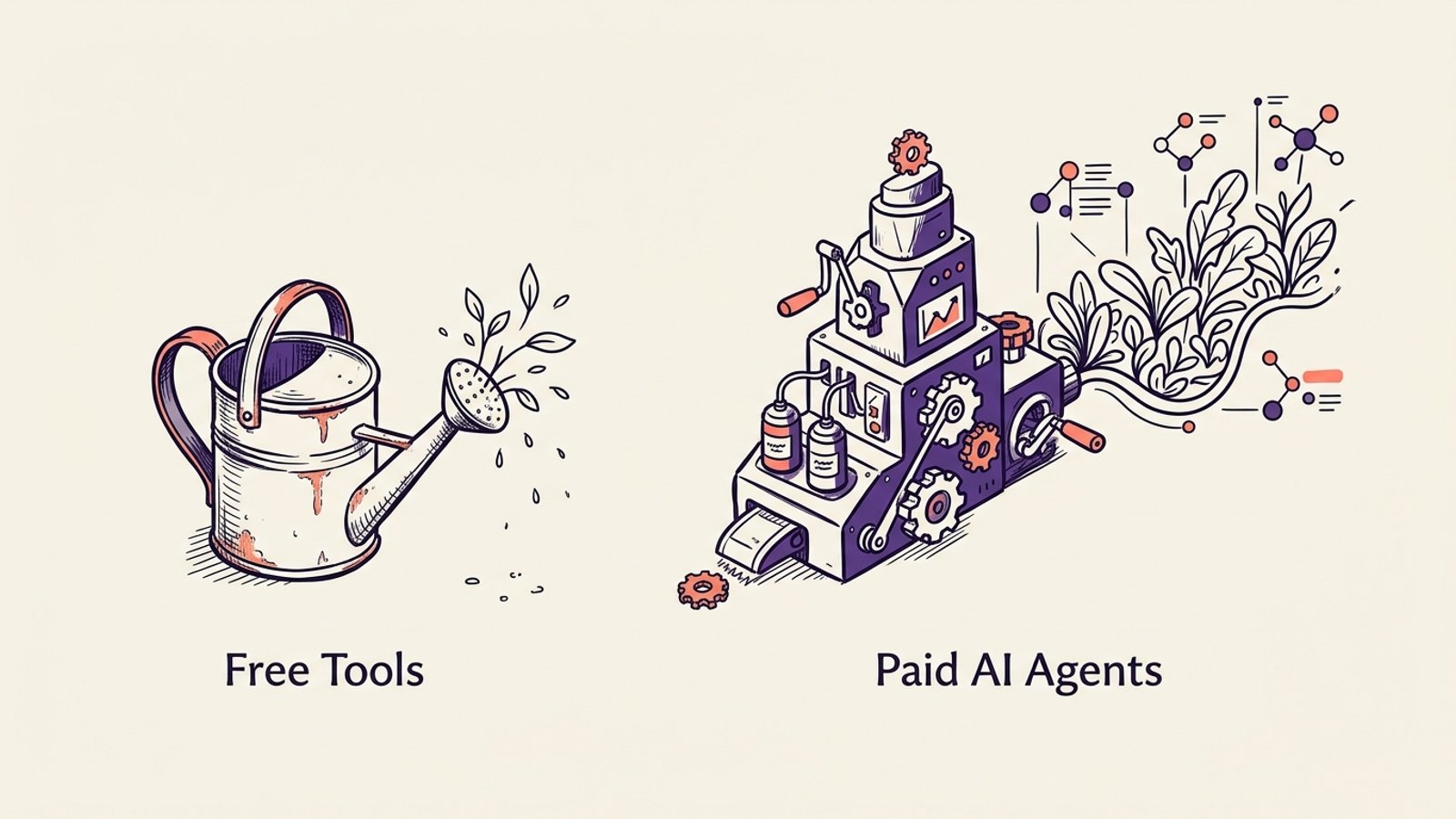
Free SEO tools are useful for checking keywords, reviewing technical issues, and validating an idea before you spend money. Paid AI agents become more valuable when your team needs a repeatable system for research, briefs, drafting, approvals, publishing, and measurement.
The real choice is not free versus paid. It is manual SEO work versus a managed production workflow.
Key Takeaways
- Free tools reduce the cost of occasional research, but they usually leave execution to your team.
- Paid AI agents can scale repeatable SEO workflows, provided they include human review and useful context.
- The best choice depends on publishing frequency, team capacity, and the cost of unfinished work.
- Google permits AI-assisted content when it helps users, but warns against scaled pages created mainly to manipulate rankings. (developers.google.com)
What Are Free SEO Software Tools Good For?
Free SEO tools work best for focused tasks such as keyword checks, basic audits, search previews, and occasional competitor research. Content Marketing Institute found that 88% of B2B marketers using generative AI relied on free tools in its 2025 benchmark, showing that low-cost access is still a practical starting point. (contentmarketinginstitute.com)
A free tool can answer a narrow question quickly. Is a page indexable? Does a keyword have commercial intent? Are title tags missing? Which queries already bring impressions? For a founder or small team publishing a few pages each month, that may be enough.
The limitation appears after the answer. Someone still has to interpret the data, choose a topic, create a brief, write the page, review claims, add links, publish it, and check performance. The tool solves one step. It does not necessarily move the project to the next one.
Best use cases for free tools
Use free SEO software when you need to:
- Validate a small list of keyword ideas.
- Run a quick technical check.
- Review search performance in Google Search Console.
- Inspect page titles, headings, and metadata.
- Learn SEO before committing to a larger workflow.
- Support an experienced specialist who already has a process.
Free tools are especially useful when your bottleneck is information, not production. They give you evidence. Your team supplies the judgment and the labor.
Where manual work starts to compound
Manual work becomes expensive when tasks repeat across many pages. A marketer might spend ten minutes checking a query, thirty minutes building a brief, two hours drafting, and another hour coordinating review. None of those tasks feels enormous alone.
Together, they create a queue. Missed publishing dates, incomplete briefs, and slow approvals become the hidden cost of a free-tool stack.
How Do Paid AI Agents Differ From Free SEO Tools?
Paid AI agents are designed to connect several SEO tasks into one operating loop. In CMI’s 2025 research, 81% of B2B marketers reported using generative AI, yet only 19% said AI was integrated into daily workflows. That gap explains why access to AI does not automatically create scale. (contentmarketinginstitute.com)
A conventional tool gives you a dashboard, report, or recommendation. An AI agent can use context from your site, apply rules, create an output, and move the work toward completion. The difference is not the word “AI.” It is the number of handoffs your team still owns.
A useful agentic workflow may include:
- Finding topics connected to your audience.
- Filtering irrelevant or weak opportunities.
- Building a content brief.
- Producing an SEO-ready draft.
- Routing the draft for approval.
- Publishing only after review.
- Tracking search performance after publication.
That workflow matters because SEO results come from connected decisions. A keyword list without a content plan is incomplete. A draft without a publishing path is unfinished. A published page without measurement is difficult to improve.
Tool versus workflow
Free tools are often excellent components. Paid agents are valuable when they coordinate those components around a repeatable outcome.
This distinction also changes how you evaluate software. Do not ask only whether a platform has keyword research or AI writing. Ask whether it preserves context between steps. Does the draft understand the target audience? Does the system avoid duplicate topics? Can a reviewer see what changed? Can the approved page reach the correct blog?
The role of human approval
Automation should reduce repetitive work, not remove accountability. Google says content created with automation can violate spam policies when it is produced at scale primarily to manipulate rankings, especially when it adds little value. (developers.google.com)
A strong paid agent therefore includes an approval gate. The system can research and draft. A human checks accuracy, positioning, tone, originality, and fit before publication.
Which Option Scales SEO Content Faster?
Paid AI agents usually scale content production faster because they reduce handoffs between research, writing, review, and publishing. CMI found that 45% of B2B marketers using generative AI reported more efficient workflows, while 51% reported fewer tedious tasks. The value comes from reducing friction across repeated work. (contentmarketinginstitute.com)
Free tools can support the same workflow, but your team must assemble it manually. That works for one article. It becomes harder when several topics compete for attention or multiple people share approvals.
The hidden cost of handoffs
Consider a simple process:
- A strategist researches topics.
- A manager chooses one.
- A writer asks for more context.
- The strategist creates a brief.
- The writer drafts the page.
- An editor requests changes.
- Someone adds metadata and links.
- Another person publishes the article.
Every handoff creates delay. It also creates context loss. The writer may not know why the topic was chosen. The editor may not know the intended search intent. The publisher may receive a file without final metadata.
The fastest SEO workflow is rarely the one with the fastest writer. It is the one with the fewest preventable handoffs between a validated idea and a published page.
Teams can use keyword difficulty data in a content plan to improve prioritization, but prioritization alone does not create throughput. The work must continue through briefing, drafting, review, and publication.
Throughput without quality loss
More pages do not automatically mean more organic traffic. Google’s guidance emphasizes helpful, reliable, people-first content rather than pages created only to attract search visits. (developers.google.com)
A scalable workflow needs quality controls at the same time as production speed. Those controls include relevant topic selection, source checking, clear authorship, editorial review, internal links, and a way to update weak pages later.
The strongest paid agents do not simply produce more text. They make the complete process easier to repeat without lowering the review standard.
Are Free SEO Tools Really Cheaper?
Free SEO software has a lower subscription cost, but it is not always cheaper for an active team. CMI reported that 56% of B2B marketers expected AI-powered automation to be a medium or high priority in 2025, suggesting that teams increasingly value time savings alongside access to data. (contentmarketinginstitute.com)
The right comparison is total cost per useful, published page. Include software fees, research time, writing time, editing, project management, publishing, and rework.
A practical cost model
Use this formula:
Total monthly SEO cost = software cost + team hours × hourly cost + rework cost
A free stack may look like this:
- Low or zero software cost.
- More time spent switching between tools.
- More manual briefing and coordination.
- Higher risk of inconsistent metadata and links.
- Slower publishing when one person is unavailable.
A paid agent may look different:
- Higher software cost.
- Less repetitive research and formatting.
- Faster movement from topic to approved draft.
- More predictable review queues.
- Better visibility into what is ready, blocked, or published.
Neither option wins automatically. If you publish two carefully researched articles per month, free tools may be the sensible choice. If your team has a backlog of validated topics but cannot execute them, the cost of staying manual may exceed the subscription.
When paid software pays back
Paid software becomes easier to justify when at least one of these conditions is true:
- You publish weekly or more often.
- Several people share the content workflow.
- Research and briefing consume most of the team’s time.
- Approvals regularly delay publication.
- You need a consistent process across multiple sites.
- You have enough traffic or revenue for small efficiency gains to matter.
In practice, teams often buy SEO software for data but keep losing time in the spaces between tools. The better buying question is, “Which unfinished step is costing us the most each month?”
What Should You Check Before Paying for an AI SEO Agent?
Before buying, test the complete workflow rather than a single generated paragraph. CMI found that accuracy concerns were the leading reason some B2B marketers avoided generative AI, cited by 35% of nonusers in its 2025 study. A useful evaluation must therefore measure speed and control together. (contentmarketinginstitute.com)
The live workflow test
Give the platform one real topic from your backlog. Then check whether it can:
- Understand your site and audience.
- Suggest a relevant angle rather than a generic one.
- Explain why the topic is worth pursuing.
- Produce a usable outline or brief.
- Draft content that matches your tone.
- Preserve factual and product boundaries.
- Route the work to a reviewer.
- Export or publish without excessive cleanup.
A demo using a polished sample rarely reveals operational friction. A real topic does.
Quality and approval safeguards
Look for these controls:
- A clear human approval step.
- Editable briefs and drafts.
- Topic history to prevent duplication.
- Source and citation support.
- Internal-link suggestions based on real pages.
- Status tracking for ideas, drafts, approvals, and publications.
- Search Console or analytics feedback.
- A way to reject or revise weak output.
Also check whether the software produces pages for a real audience. Google’s spam policies specifically warn against scaled content abuse, which includes generating many pages mainly to manipulate search rankings. (developers.google.com)
A paid agent should make thoughtful publishing easier, not make low-value publishing faster.
Can Free Tools and Paid AI Agents Work Together?
A hybrid stack is often the best transition path. CMI reported that 49% of B2B marketers used AI tools inside content creation or management systems, while 32% paid for AI tools in its 2025 benchmark. The numbers suggest that teams commonly combine free access, paid systems, and existing workflows. (contentmarketinginstitute.com)
Use free tools for independent verification and paid software for repeatable execution. This keeps your team from treating one platform’s recommendation as unquestionable truth.
A practical hybrid stack
Free or existing tools can handle:
- Search Console checks.
- Basic technical validation.
- Manual SERP review.
- Independent fact checking.
- Final review of titles and metadata.
A paid AI agent can handle:
- Topic discovery and prioritization.
- Brief generation.
- First-draft production.
- Workflow status and assignments.
- Approval routing.
- Publishing coordination.
- Post-publication tracking.
This division gives the team leverage without surrendering editorial judgment.
For teams focused on consistency, an AI-first SEO workflow with human control provides a useful operating model. Approval should be part of the system, not an informal message sent after the draft is finished.
A weekly operating cadence
A small team can run the workflow like this:
- Monday: review new topics and select priorities.
- Tuesday: inspect briefs and request changes.
- Wednesday: review completed drafts.
- Thursday: approve, edit, and prepare publication.
- Friday: inspect early performance and update the queue.
The exact days do not matter. The repeatable rhythm does.
Which SEO Workflow Should Your Team Choose?
The best choice depends on publishing cadence, internal expertise, and the cost of delay. CMI found that 92% of B2B marketers used short articles or posts during the previous year, which means the operational challenge is not whether teams create content. It is whether they can create useful content consistently. (contentmarketinginstitute.com)
Choose free tools if
Free SEO software is a good fit when:
- You publish occasionally.
- One person owns most SEO decisions.
- You enjoy manual research and editing.
- Your topic queue is small.
- You are still learning which workflow you need.
- The cost of delay is low.
Free tools are also a good way to establish standards before automating them. Define your audience, approval criteria, content formats, and measurement approach first.
Choose a paid agent if
A paid AI agent is more likely to pay off when:
- You have a consistent publishing target.
- Your team cannot keep up with research or drafting.
- Multiple people need shared workflow visibility.
- Approvals are slowing down publication.
- You need content on a predictable schedule.
- You want one system to connect topics, drafts, approvals, publishing, and performance.
The decision matrix is simple:
| Situation | Better starting point |
|---|---|
| A few articles per quarter | Free SEO tools |
| Learning SEO fundamentals | Free SEO tools |
| Weekly publishing by a small team | Paid AI agent or hybrid stack |
| Multiple reviewers and deadlines | Paid AI agent |
| Several sites or content programs | Paid AI agent |
| Need for independent verification | Hybrid stack |
Build your own comparison from one month of work. Track hours spent on research, briefing, drafting, review, and publishing. Then compare those hours with the time required by a managed workflow. Your process data is more useful than a generic promise of “10x productivity.”
If approvals are the main bottleneck, review the features that matter in approval workflow software. If publishing and crawlability are the concern, start with how a crawlable SEO blog supports publishing.
FAQ
Are free SEO software tools enough for a small business?
Yes, if the business publishes infrequently and has someone available to interpret the data. Free tools can support keyword checks, basic audits, and Search Console reviews. The limitation is usually execution, not access. When research, drafting, approvals, and publishing become a weekly workload, a paid workflow may save more time than the free subscription saves money.
Do paid AI SEO agents replace SEO specialists?
Usually, no. They can reduce repetitive research, drafting, and coordination, but a specialist still provides positioning, judgment, fact checking, and quality control. Google’s guidance focuses on helpful content and warns against scaled content created mainly to manipulate rankings, so human oversight remains an important safeguard. (developers.google.com)
Is AI-generated content safe for SEO?
AI-assisted content can be safe when it is accurate, useful, original, and created for people rather than search manipulation. Google does not ban content solely because AI helped produce it. However, generating many low-value pages without adding meaningful value can violate its scaled content abuse policy. (developers.google.com)
What is the biggest advantage of a paid AI SEO agent?
The biggest advantage is workflow continuity. Instead of moving manually between keyword research, briefs, drafts, approvals, and publishing, the team can manage those steps in one repeatable process. That reduces context switching and makes it easier to maintain a consistent publishing cadence without removing editorial review.
Should a team start with free tools before buying?
Often, yes. Start by documenting one complete SEO workflow and measuring where time disappears. If free tools solve the information problem but leave research, drafting, or approval queues untouched, that evidence gives you a stronger reason to test paid automation. Buy for a proven bottleneck, not for a feature list.
About the author
Sultan Kadyrkesh is the CEO of vibeseo.dev. He writes about practical AI SEO, content automation, crawlable blogs, approval workflows, and the systems teams use to publish faster without losing editorial control.
Conclusion
Free SEO software tools are valuable when your team needs occasional research, verification, or basic technical insight. They are not automatically a complete content system.
Paid AI agents make more sense when the problem is repeated execution. They can connect topic discovery, briefs, drafting, review, publishing, and measurement into one operating loop. The strongest setup still keeps a human in control of relevance, accuracy, and final approval.
Start with your bottleneck. If you need better information, use free tools. If you have enough information but cannot turn it into approved, published pages, test a workflow built for scale.
Ready to see where your current SEO workflow slows down? Analyze your website and identify the next practical improvement.
Frequently asked questions
Are free SEO software tools enough for a small business?
Yes, if the business publishes infrequently and has someone available to interpret the data. Free tools can support keyword checks, basic audits, and Search Console reviews. The limitation is usually execution, not access. When research, drafting, approvals, and publishing become a weekly workload, a paid workflow may save more time than the free subscription saves money.
Do paid AI SEO agents replace SEO specialists?
Usually, no. They can reduce repetitive research, drafting, and coordination, but a specialist still provides positioning, judgment, fact checking, and quality control. Google’s guidance focuses on helpful content and warns against scaled content created mainly to manipulate rankings, so human oversight remains an important safeguard.
Is AI-generated content safe for SEO?
AI-assisted content can be safe when it is accurate, useful, original, and created for people rather than search manipulation. Google does not ban content solely because AI helped produce it. However, generating many low-value pages without adding meaningful value can violate its scaled content abuse policy.
What is the biggest advantage of a paid AI SEO agent?
The biggest advantage is workflow continuity. Instead of moving manually between keyword research, briefs, drafts, approvals, and publishing, the team can manage those steps in one repeatable process. That reduces context switching and makes it easier to maintain a consistent publishing cadence without removing editorial review.
Should a team start with free tools before buying?
Often, yes. Start by documenting one complete SEO workflow and measuring where time disappears. If free tools solve the information problem but leave research, drafting, or approval queues untouched, that evidence gives you a stronger reason to test paid automation. Buy for a proven bottleneck, not for a feature list.