AEO vs. SEO: What to Keep, What to Change, and How to Use Both Together
What Is the Difference Between AEO and SEO?
Pew Research Center found that 18% of Google searches produced an AI-generated summary in March 2025, while question-based searches produced summaries 60% of the time (Pew Research Center, 2025). SEO helps content get discovered; AEO helps its meaning get identified and used in generated answers.
Key Takeaways
- SEO remains the foundation for crawling, indexing, rankings, clicks, and conversions.
- AEO adds direct answers, clear structure, evidence, and source attribution.
- In Pew's 2025 study, 88% of AI summaries cited at least three sources.
- The practical strategy is to improve important SEO pages for both readers and answer systems.
Search engine optimization focuses on discoverability. It includes keyword research, search intent, crawlability, page speed, internal linking, authority, and content quality. The usual outcomes are rankings, impressions, clicks, leads, and revenue.
Answer engine optimization focuses on comprehension and selection. The content should make it easy for a system to identify the question, locate the answer, understand the source, and connect the claim to a trusted entity or website.
The terms overlap. A well-structured page can rank in traditional results and support an AI-generated answer. A page written only for extraction may earn a brief mention but fail to satisfy readers who want examples, evidence, or a next step.
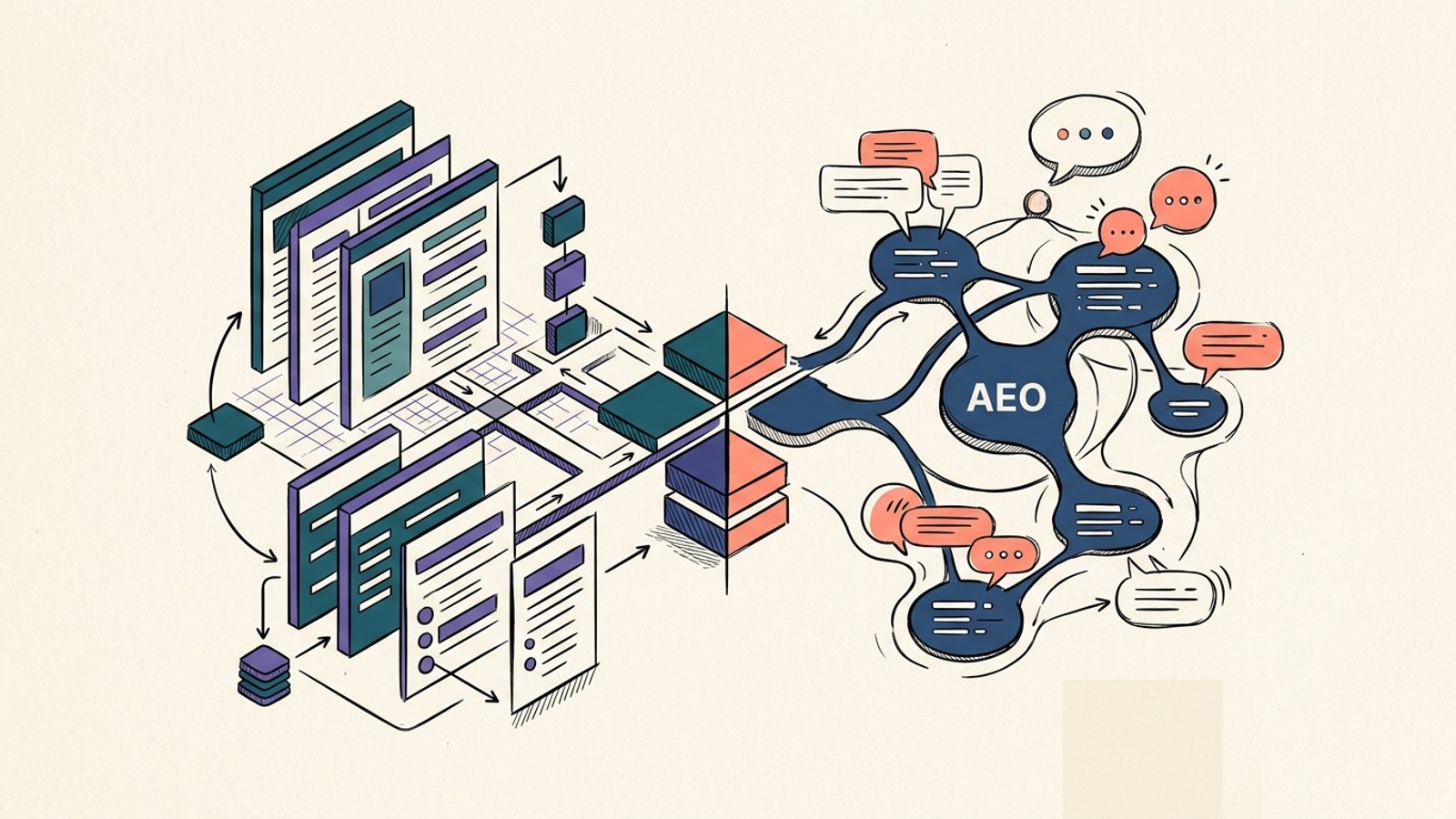
A useful distinction is this: SEO is the distribution layer, while AEO is the interpretation layer. One helps your content get found. The other helps its meaning survive summarization.
SEO focuses on rankings and clicks
SEO still matters because answer systems generally work with publicly accessible web content. Google says the same search fundamentals apply to AI Overviews and AI Mode, including making pages crawlable, indexable, and useful.
AEO focuses on answers, visibility, and citations
AEO is not a separate Google ranking system. It is a practical way to improve how clearly a page answers a question, supports its claims, identifies relevant entities, and gives systems a reliable passage to interpret or cite.
What Should You Keep From Traditional SEO?
Google reported in 2025 that AI Overviews increased usage of Google by more than 10% for query types that showed the feature (Google, 2025). That change makes SEO foundations more valuable, not less. Keep intent research, crawlability, useful content, internal links, technical quality, and conversion paths.
Keep search intent first. A page should answer the reason behind the query, whether the reader wants a definition, comparison, process, recommendation, or product evaluation. AEO does not make intent research less important. It makes mismatched intent easier to expose.
Keep technical accessibility. Important content must be indexable, internally linked, mobile-friendly, and available to crawlers. Google says its generative search systems use publicly accessible, crawlable content (Google Search Central, 2026). Robots rules, canonicals, rendering, and site architecture still matter.
Keep topic depth and evidence. A short answer can earn attention, but supporting detail gives readers reasons to trust the answer and continue. Keep author attribution, useful examples, original analysis, and clear update dates.
Keep conversion paths too. Search visibility without a relevant next action is not a complete marketing result. Guide readers toward a related resource, comparison, signup, demo, or other meaningful action.
Keep technical accessibility
Check that important pages return a successful status code, have a clear canonical, can be crawled, and receive internal links. Technical access cannot guarantee an AI citation, but blocked or poorly connected content cannot compete reliably.
Keep topic research and search intent
Use keyword research to understand language, demand, and competition. Then map each query to the page that best satisfies its intent. A practical keyword mapping guide can help prevent multiple pages from competing for the same question.
What Needs to Change for AEO?
Pew found that users clicked a traditional result on 8% of visits when an AI summary appeared, compared with 15% when no summary appeared, and clicked a cited link inside the summary on only 1% of visits (Pew Research Center, 2025). That makes clear, trusted answers important even when the first interaction does not produce a click.
Start sections with a direct answer. Do not make readers scan several paragraphs before finding the definition. State the conclusion first, then explain the conditions, evidence, exceptions, and practical implications.
Use specific language. Replace vague phrases such as “many businesses” with a defined audience. Replace “improves performance” with the exact outcome, such as faster review, clearer prioritization, or more qualified conversions.
Make claims easy to verify. Name the source, include the publication year, and separate external evidence from your own observation. If a number comes from an internal test, describe the sample and method. If you cannot verify a claim, remove the number.
Use recognizable structures. Definitions, comparison tables, step lists, pros-and-cons sections, FAQs, examples, and short summaries help both people and systems parse the page.
In practice, the biggest mistake is treating AEO as a collection of formatting tricks. Clear headings help, but answer quality depends more on whether the page gives a precise, supported answer to a real question.
Write extractable answer blocks
Open each major section with a concise answer. Follow it with context, limitations, examples, or steps. This creates a useful passage without turning the entire page into disconnected snippets.
Add evidence and first-hand context
Document what you observed, tested, or measured. For example, record the query, date, search feature, cited sources, and resulting action when reviewing answer visibility. That method is more credible than labeling a paragraph “original data” without showing how the data was collected.
How Should You Structure Content for Both?
Google's 2025 Search update said AI Overviews were driving more than a 10% increase in usage for query types that generated the feature (Google, 2025). Structure pages for the longer, more complex questions that search systems increasingly support, while keeping the content useful to people who want depth.
A strong AEO and SEO page usually follows this pattern:
- Open with the answer. Define the topic or give the recommendation in 40 to 60 words.
- Explain the distinction. Tell readers what changes and what does not.
- Add supporting evidence. Use named sources, dates, examples, and limitations.
- Organize by questions. Use headings that reflect how a reader would ask the topic.
- Show the application. Include a workflow, checklist, example, or decision framework.
- Offer the next step. Link to a relevant resource or action without forcing a sales pitch.
A comparison table can reduce ambiguity:
| Area | SEO emphasis | AEO emphasis |
|---|---|---|
| Main goal | Earn search visibility and clicks | Earn inclusion, citation, or mention in answers |
| Core unit | Page and query | Claim, answer, entity, and source |
| Writing style | Complete and relevant | Direct, structured, and easy to interpret |
| Measurement | Rankings, clicks, conversions | Mentions, citations, answer visibility, and assisted demand |
| Best use | Building durable organic traffic | Improving visibility in answer-led interfaces |
Place internal links where they answer the reader's next question. A page about AEO can point to an answer engine optimization guide for deeper implementation advice. A discussion of publishing operations can reference an AI-first SEO workflow.
Use structured data only when it describes visible, accurate page content. Google supports JSON-LD, Microdata, and RDFa, but valid markup does not guarantee a rich result or an AI citation (Google Search Central, 2026).
Build answer-first sections
Use a question-based heading, answer it immediately, then support the answer with evidence and application. Avoid opening with generic background that delays the main point.
Connect pages with internal links
Link from this article to closely related guides and use descriptive anchors. The link should help readers move from the general AEO versus SEO question to a more specific workflow, implementation guide, or planning process.
How Do You Measure AEO and SEO Together?
Pew's 2025 analysis reviewed 68,879 unique Google searches from 900 U.S. adults, and 26% of visits with an AI summary ended the browsing session compared with 16% without one (Pew Research Center, 2025). Measure traffic and conversions, but also track whether your content is visible and accurately represented in answer features.
For SEO, monitor:
- Organic impressions and clicks
- Average position by query group
- Click-through rate
- Non-branded traffic
- Assisted conversions and revenue
- Indexing and crawl issues
For AEO, monitor:
- Whether your brand or page appears in answer features
- Which questions generate mentions
- Whether cited pages earn branded searches afterward
- Referral traffic from AI and answer interfaces
- Changes in direct traffic, repeat visits, and assisted conversions
- The accuracy and consistency of answers about your business
Do not judge AEO only by clicks. An answer mention may influence a later branded search, direct visit, or sales conversation. At the same time, impressions or mentions alone do not prove business impact. Connect visibility signals to qualified actions wherever possible.
A useful monthly review log should include the question, date, search feature, sources cited, whether your brand appeared, the target page, and any change in clicks or conversions. Reviewing the same query set over time makes the process more reliable than occasional manual searches.
SEO metrics
Use Google Search Console for impressions, clicks, click-through rate, average position, queries, and landing pages. Segment the data by branded versus non-branded queries and by informational versus commercial intent.
AEO visibility signals
Record answer appearances, citations, brand mentions, referral visits, and assisted conversions. Also check factual accuracy. A page that is mentioned but misrepresented needs editorial correction, not just more exposure.
What Is the Best AEO vs SEO Strategy?
Google said in 2025 that more than 1.5 billion people used Google Lens each month and that AI Overviews increased usage for eligible query types by more than 10% (Google, 2025). The best strategy is additive: protect technical SEO, then improve answer clarity on pages that matter to customers and revenue.
Use this 30-day workflow:
Days 1 to 7: Select priority pages
Choose pages with strong impressions, valuable conversions, or important customer questions. Exclude pages that are thin, outdated, duplicated, or disconnected from business goals.
Days 8 to 14: Improve answer clarity
Rewrite introductions, add question-based headings, define key terms, tighten paragraphs, and place the primary answer near the top. Add sources for important claims.
Days 15 to 21: Add depth and connections
Include examples, decision criteria, FAQs, original observations, and relevant internal links. A page about content operations can connect naturally to a content planning workflow.
Days 22 to 30: Measure and refresh
Record rankings, impressions, clicks, conversions, branded demand, and answer visibility. Keep changes that improve qualified outcomes. Revise pages that gain impressions but fail to answer the reader's real question.
Avoid three common mistakes. First, do not remove useful detail just to create short answer blocks. Second, do not add structured data to questions that are not visible on the page. Third, do not publish generic AI-written summaries without original analysis or editorial review.
FAQ: AEO vs SEO
Is AEO replacing SEO?
No. Google says its AI features still rely on existing SEO fundamentals, including crawlability and useful content. AEO adds clearer answers, stronger evidence, and more structured presentation. Use it to improve how content is interpreted, not as a replacement for technical SEO, search intent, or conversion-focused content.
Does Google have separate AEO ranking requirements?
Google says there are no additional technical requirements or special optimizations for appearing in AI Overviews or AI Mode. The practical opportunity is to make useful content easier to understand, verify, and connect to relevant questions while maintaining normal SEO quality.
Should every SEO article include FAQ schema?
No. Add FAQ structured data only when the questions and answers are visible, accurate, relevant, and compliant with Google's guidelines. Structured data can make a feature eligible, but Google does not guarantee that the feature will appear. Clear page content remains the priority.
What should I optimize first for AEO?
Start with pages that answer high-value customer questions and already receive impressions. Improve the opening answer, heading structure, evidence, examples, author information, and internal links. Then monitor whether visibility, qualified traffic, branded searches, or conversions improve.
Can AEO help a page that does not rank well?
AEO cannot compensate for severe technical or relevance problems. A page must still be crawlable, useful, and connected to the site's topic authority. Clear answer blocks may improve comprehension, but they work best when built on a sound SEO foundation.
About the Author
Sultan Kadyrkesh is the CEO of VibeSEO and writes about SEO workflows, answer engine optimization, content automation, and approval-based publishing. His public professional profile also identifies him as a former CTO and backend developer, giving him technical experience relevant to the systems discussed in this article. His work focuses on helping marketing teams turn search research into reviewed, publishable content.
The published page should connect this byline to a dedicated Sultan Kadyrkesh author profile and a Person entity in Article schema, including his name, role, author URL, organization, LinkedIn profile, and stable entity ID.
Conclusion
AEO vs SEO is not an either-or decision. SEO still provides the foundation: crawlable pages, relevant topics, useful content, internal links, and measurable organic visibility. AEO changes how you package that value by putting direct answers, clear entities, evidence, and interpretable structure closer to the surface.
Start with a small group of important pages. Keep the technical basics. Rewrite openings, strengthen sources, add practical examples, and measure both traffic and answer visibility. The teams that win will not abandon search optimization. They will make their best information easier for every search interface to understand and use.
Frequently asked questions
Is AEO replacing SEO?
No. Google says its AI features still rely on existing SEO fundamentals, including crawlability and useful content. AEO adds clearer answers, stronger evidence, and more structured presentation. Use it to improve how content is interpreted, not as a replacement for technical SEO, search intent, or conversion-focused content.
Does Google have separate AEO ranking requirements?
Google says there are no additional technical requirements or special optimizations for appearing in AI Overviews or AI Mode. The practical opportunity is to make useful content easier to understand, verify, and connect to relevant questions while maintaining normal SEO quality.
Should every SEO article include FAQ schema?
No. Add FAQ structured data only when the questions and answers are visible, accurate, relevant, and compliant with Google's guidelines. Structured data can make a feature eligible, but Google does not guarantee that the feature will appear. Clear page content remains the priority.
What should I optimize first for AEO?
Start with pages that answer high-value customer questions and already receive impressions. Improve the opening answer, heading structure, evidence, examples, author information, and internal links. Then monitor whether visibility, qualified traffic, branded searches, or conversions improve.
Can AEO help a page that does not rank well?
AEO cannot compensate for severe technical or relevance problems. A page must still be crawlable, useful, and connected to the site's topic authority. Clear answer blocks may improve comprehension, but they work best when built on a sound SEO foundation.